

Home / Sculpting / Making a Mold / Casting / Painting / Gem Making Tutorial / Links / Contact Me



Introduction
The following is a quick 'n' dirty casting guide for the casual costumer based on my own personal experience. I deliberately tried to keep my methods and materials low-tech and readily available - indeed, most of the items I use to cast can be readily bought at most craft store chains. As you gain more experience casting things, you'll probably want to move on to more advanced materials, which you'll have to buy at stores and websites which provide plastics and resins for professional sculptors. (I've posted a list of such places on my Links Page.)
Materials you will need for sculpting and casting the AA Way:
Sculpting tools and polymer clay:
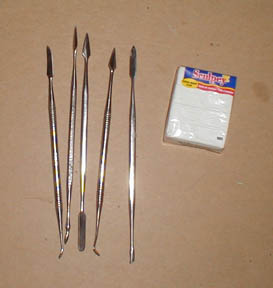
For sculpting small, detailed items, I'd recommend a nice set of Double-Ended Wax Carving Tools, like the ones pictured above or the ones found on this page. (These tools are also called Dental Tools and can be readily found on ebay..) Most craft stores carry sculpting tools of some sort as well. They also carry most brands of polymer clay, which is what you'll want to use to make the item that you'll be casting. (You can also use modelling clay to make your original, but it won't harden and may become damaged or destroyed during the casting process. If you make your original out of polymer clay and harden it in the oven, you can make more than one mold from it.)
Other materials:
Casting Latex
Resin and Catalyst
Brushes
Plastic or paper cups for mixing
A plastic knife
Testor's enamel paint.
Silicone
I will go into more detail about these items later. For now let us move onto Part I of my guide:
Sculpting the Original



